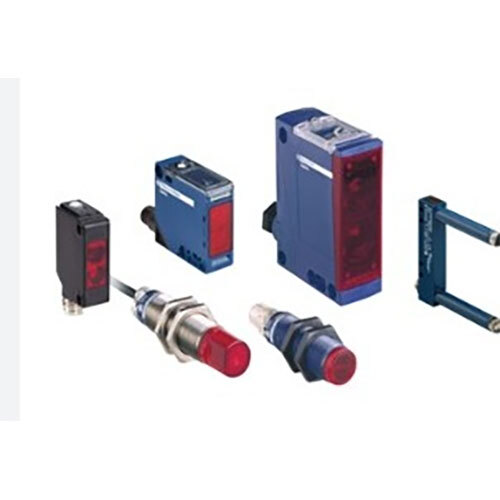
About Banner Make Fiber Optic Photoelectric Sensor
- Fiber optics are used to transmit light energy over long distances. Optical fibers are thin, transparent strands of optical quality glass or plastic that can be as thin as a strand of hair. In photoelectric sensing, these fibers are used to transmit and/or receive light from the LED of a sensor.
High-Speed, Flexible DetectionFeaturing a swift 0.5 ms response time and adaptable sensing distance, the sensor excels in environments where speed and flexibility are essential. The use of fiber optics allows tailored configurations across diverse industrial applications.
Reliable, Durable ConstructionBuilt with a polycarbonate housing and rated at IP50, this sensor offers robust protection against dust, while its yellow and black PVC finish ensures high visibility. The unit is lightweight and easily mounts to DIN rails or panels, streamlining installation and maintenance processes.
Clear Status Monitoring and Efficient OutputThe device includes an LED status indicator for quick operational checks. It delivers up to 100 mA control output and supports up to 2 kHz cutoff frequency, ensuring accuracy and efficiency, while its open collector output interfaces seamlessly with PLCs and other control systems.
FAQ's of Banner Make Fiber Optic Photoelectric Sensor:
Q: How do I mount the Banner Fiber Optic Photoelectric Sensor in my setup?
A: You can install the sensor using either a DIN rail or a panel mount. Both options provide secure and stable attachment, catering to various industrial layouts and ensuring easy integration into existing systems.
Q: What are the advantages of using a fiber optic photoelectric sensor in industrial automation?
A: Fiber optic photoelectric sensors are advantageous for their quick response time, adjustable sensing distance (depending on the chosen fiber), high accuracy (up to 99%), and immunity to electrical noise. They are suitable for detecting small or fast-moving objects in challenging industrial environments.
Q: When is this sensor most beneficial for industrial applications?
A: This sensor is most beneficial in high-speed automation, packaging, or process lines where fast response, flexible sensing range, and reliable detection of small objects are crucial. Its accurate and swift operation enhances productivity and minimizes errors.
Q: What is the process for adjusting the sensing distance on this sensor?
A: The sensing distance depends on the specific fiber optic cable used. By selecting the appropriate fiber type and length, you can tailor the detection range for your application, often achieving several meters of sensing distance.
Q: Where can I find the indicator for the sensor's status and what does it show?
A: The sensor features an LED status indicator located on its housing. This LED provides immediate visual feedback on detection and operation, enabling quick diagnostics and maintenance checks.
Q: How do the output types (NPN/PNP open collector) enhance compatibility?
A: With both NPN and PNP open collector outputs, the sensor offers broad compatibility with a wide range of industrial control systems and PLCs. This flexibility ensures easy integration into new or existing automation infrastructures.

 Send Inquiry



 Send Inquiry


 Send Inquiry


 English
 Spanish
 French
 German
 Italian
 Chinese (Simplified)
 Japanese
 Korean
 Arabic
 Portuguese